


This is the reference page for the NiSi JetMag Pro True Color ND-VARIO — the magnetic variable ND in the JetMag Pro system. Full specifications first, then how each feature actually behaves in use, and answers to the questions we get asked most.
If what you actually want is whether to buy this or the screw-in True Color ND-VARIO, that comparison has its own page — jump straight there.
Specifications
| ND range | 1 to 5 stops |
| Optical density | 0.3 to 1.5 |
| Filter factor | ND2 to ND32 |
| Sizes | 49MAG, 67MAG, 82MAG, 95MAG |
| Mount | Magnetic, with patented lock. Requires a JetMag Pro adapter ring — not included |
| Front thread | None. The filter is unthreaded: further filters attach magnetically, not by screwing in |
| Glass | True Color optical glass — the same glass as the screw-in True Color ND-VARIO |
| Coating | Nano coating — water, oil and dust resistant, low reflection |
| Frame | Ultra-slim aluminium |
| Rotation | Hard stops at 1 and 5 stops; dual-sided stop markings; detachable control lever, mountable either side |
| Polarisation | Yes — rotate the whole filter after setting the density |
| Vignetting | No vignetting on a 16mm full-frame lens; the system supports two stacked filters on lenses as wide as 15mm |
| Announced | May 2025 |
Two things are not on that list because NiSi does not publish them: filter weight and glass thickness. If you need either for a specific rig, ask us and we will weigh one.


The built-in polarisation control
This is the feature people ask about most, and the answer is yes: the JetMag Pro ND-VARIO polarises. It is not a separate CPL bolted on — it comes out of how a variable ND is built.
Every variable ND is two polarising elements rotating against each other. Turning the lever changes the angle between them, and that sets the density. But you can also rotate the whole filter in its adapter ring, which keeps the two elements at the same angle to each other — density unchanged — while turning them both relative to the scene. That is exactly what a circular polariser does.
So the working order is: set your density with the lever, then rotate the whole filter to place the polarisation. Reflections come off water and glass, wet foliage stops glaring, skies deepen — and your exposure does not move.
One honest caveat: a dedicated True Color CPL still gives you polarisation without any density, which the VND cannot do — it always costs you at least one stop. If you want polarisation on its own, that is the filter for it.
Hard stops, and why the range ends at five
The rotation has firm mechanical stops at 1 stop and at 5 stops. You feel where the range ends instead of hunting for it on a scale, which matters when you are adjusting mid-take, and it makes it impossible to over-rotate past the usable range.
That five-stop ceiling is a deliberate design decision, not a limitation. Push a variable ND towards its two polarisers being crossed and you get the X pattern — the dark cross that appears on wide lenses and cannot be fixed in post. Filters advertising nine or ten stops reach those numbers by going into exactly that territory. NiSi stops the range before it, and gets you to nine stops by stacking instead. We explain the mechanism in full in our guide to variable ND filters.
Sizes, adapter rings and what fits your lenses
The filter itself comes in four sizes: 49MAG, 67MAG, 82MAG and 95MAG. That is the magnetic size, not your lens thread — you buy the filter once in the size that covers your largest lens, then an adapter ring for each thread you own. The ring is threaded on the lens side and magnetic on the front.
| Filter size | Adapter rings available |
|---|---|
| 67MAG | 52, 55, 58, 62, 67mm |
| 82MAG | 67, 72, 77, 82mm |
| 95MAG | 82, 86, 95mm |
Two things worth knowing before you order:
- The rings for the Sony 14mm f/1.8, Nikkor Z 14-24mm f/2.8, Canon RF 14mm f/1.4 L and Olympus 7-14mm f/2.8 are only compatible with MaxMag filters. The ND-VARIO is not made in MaxMag, so those lenses are not covered by this filter.
- The 95mm clamp exists only for cinema lenses with a 95mm front diameter.
-
Accessories
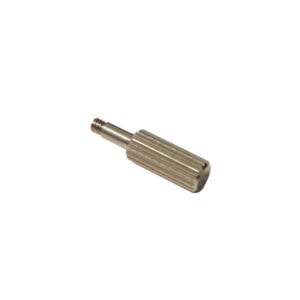 Pin Kit for VND (6 PCS)
 -
JetMag Pro
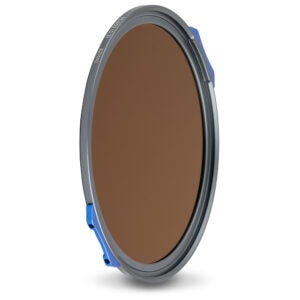 JetMag Pro – FS ND Filters
 -
JetMag Pro
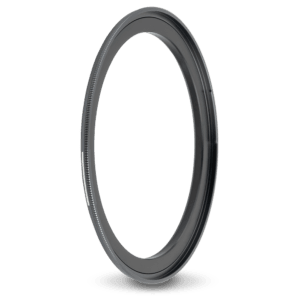 JetMag Pro – Adapter Rings
Mounting it, and the lock
Three steps, and it is the third one that people get wrong the first time.
- Screw the adapter ring onto the lens. One ring per thread size. It can stay there permanently — a magnetic front cap takes the place of the lens cap.
- Bring the filter close and let it snap on. The magnets pull it in and centre it themselves. Nothing to line up at this stage.
- Rotate the filter until the coloured lever lines up with the white mark on the ring. That is the lock engaging. Until they are aligned the filter is held by magnets alone; once they are, it is mechanically latched and will not shift if the camera knocks against something.
The one thing to avoid: do not offer the filter up with the lever already aligned to the white mark — the lock will not catch. Snap it on anywhere else, then turn it into the mark.
To take it off, rotate the other way until the lever leaves the mark, and lift it clear.
The lever, the markings and the pins
The control lever is detachable and mounts on either side of the filter, so it falls under your finger whichever way the camera is rigged. It is the difference between adjusting density with a fingertip and taking your hand off the camera — and it works with gloves on, or on a gimbal where you cannot get a whole hand in.

The stop markings are printed on both sides, so you can read the setting from above the camera or from behind it without leaning around the lens.
The lever mounts on a small stainless steel pin. One spare pin is included with every VND, and a six-pin kit is available separately if you lose or damage one — it fits the screw-in True Color VND and the Swift CPL as well.
Across the JetMag Pro range the lever colour tells you what the filter is without reading it: blue for ND and GND, gold for the diffusion filters, silver for CPL and Cross Screen, purple for Natural Night, green for UV and UV/IR.
Glass, coating and weather
The glass is the same True Color optical glass used in the screw-in ND-VARIO — same range, same neutrality across the rotation. What changes between the two filters is everything around the glass, not the glass itself.
On top of it goes NiSi’s nano coating: water and oil repellent, dust resistant, and low-reflection to control the flare and ghosting that extra glass surfaces invite. In practice it means a splash beads up and wipes off in one pass instead of smearing.

Being precise about that last point, because it matters: a coating is not a seal. Every variable ND, this one included, is built from two elements that rotate against each other, so it is not a weatherproof filter. In driving rain or sea spray a fixed ND is the safer tool.
The frame is ultra-slim aluminium, and that is the specification that decides whether you see vignetting. A single ND-VARIO shows none on a 16mm full-frame lens, and the system is designed so that two stacked JetMag Pro filters clear a 15mm lens — which is the number that matters, because stacking is how you get past five stops.
Going past five stops
Bright sun at a wide aperture needs more than five stops — around eight at f/1.8, and eleven if your base ISO is 800. You get there by snapping a fixed JetMag Pro FS ND onto the front of the VND. A 4-stop turns 1-5 into 5-9 stops (ND2 to ND512); a 6-stop takes you to eleven.

Because both filters are magnetic they go on and come apart in one movement, and the slim frames keep the stack clear of the corners. Two ready-made combinations:
- Flex Kit — the 1-5 stop VND with the full set of adapter rings for your chosen size, front and back magnetic caps and a caddy pouch.
- Creator Kit — the same, plus a 4-stop FS ND to reach nine stops and a 1/8 Black Mist for diffusion.

JetMag Pro or Swift?
A fair question, since both let you add filters on top of a variable ND. The difference is how they attach.
Swift stacks by press-fit onto a screw-in variable ND. It works, but every added element sits further forward, so vignetting arrives sooner on wide lenses. JetMag Pro is magnetic throughout: filters snap to each other and to the adapter ring, with a patented lock so nothing rotates or drops off. It is the slimmer, faster system, and it is the one NiSi is building out — the JetMag Pro range now runs from ND and GND through mist and diffusion to UV/IR, Natural Night and the 100mm holder.
If you are starting from nothing today, start on JetMag Pro.

Frequently asked questions
Does the JetMag Pro ND-VARIO have a built-in CPL?
It polarises, yes. Set the density with the lever, then rotate the entire filter in its adapter ring to place the polarisation without changing the exposure. It is not a separate CPL element — it is the two polarisers the filter is already made of, turned together.
How do I fit it, and what is the white mark for?
Screw the adapter ring onto the lens, let the filter snap onto it magnetically, then rotate the filter until the coloured lever lines up with the white mark on the ring. That alignment is the mechanical lock. Do not present the filter with the lever already on the mark — it will not latch.
What is the stop range?
1 to 5 stops, density 0.3 to 1.5, filter factor ND2 to ND32, with hard stops at both ends. Stack a 4-stop FS ND on top for 5 to 9 stops.
Is the glass the same as the screw-in True Color ND-VARIO?
Yes. Same True Color optical glass, same 1 to 5 stop range, same nano coating. Optically the two filters are the same filter. What you are paying the difference for is everything around the glass: magnetic attachment with the patented lock, the detachable lever, dual-sided markings, and a frame slim enough to stack a second filter on a wide lens.
Does it have a front filter thread?
No. The filter is unthreaded on both sides — it attaches magnetically to the adapter ring, and anything you add on top attaches magnetically to it. You cannot screw a step-up ring or a threaded filter onto the front.
Do I need an adapter ring?
Yes, and it is not included. One ring per lens thread, then the same filter serves every lens you own.
Can I use it on a 14mm lens?
Not on the ultra-wides that need a MaxMag ring — the Sony 14mm f/1.8, Nikkor Z 14-24mm f/2.8, Canon RF 14mm f/1.4 L and Olympus 7-14mm f/2.8. The ND-VARIO is not made in MaxMag. On conventional wide lenses it is clear at 16mm full-frame.
Is it weatherproof?
No. The nano coating repels water and makes cleaning easy, but the filter is two elements rotating against each other and is not sealed. In heavy rain or spray, use a fixed ND.
When was it released?
May 2025.
Which size, and which kit?
Tell the Filter Finder what camera and lenses you shoot with and it will work out the filter size, the adapter rings you need for each lens, and whether a kit works out better than the parts — with two alternatives, so you can see what you are choosing between.
Or ask us directly — tell us your lenses and what you shoot, and we will tell you what fits. We answer every message ourselves.


